

Parkinson’s Law: why the productivity gain you bought rarely lands on the P&L

When work moves out of an operation, whether automated, AI-handled, outsourced, or restructured, the freed time rarely shows up as a durable productivity gain. The mechanism is structural, not moral. The intervention barely matters. The discipline required to hold the gain does.
Parkinson’s Law was never really about laziness.
In November 1955, the British naval historian C. Northcote Parkinson published a satirical essay in The Economist. He’d been studying the Royal Admiralty. Between 1914 and 1928, the Royal Navy lost two-thirds of its capital ships while the Admiralty’s administrative staff grew by 78 percent.
Parkinson did not editorialize. He did not have to.
His famous line, “work expands so as to fill the time available for its completion,” captured a pattern he’d been observing across the British civil service for years. The Colonial Office grew as the empire it administered dissolved. The Admiralty grew as the fleet shrank. Bureaucracies, Parkinson concluded, weren’t calibrated to workload. They calibrated themselves to the time and budget available.
Seventy-one years later, the pattern has a name and an evidence base behind it.
Parkinson’s Law is not a character judgment. It’s an organizational one.
It describes what happens in the absence of countervailing pressure: work expands to fill whatever container it’s placed inside. Calendar time. Headcount. Budget. Queue depth. Work rarely takes the time it objectively needs. It takes the time the organization tolerates.
This is one of the most consistently misunderstood dynamics in operations, and it doesn’t care which intervention you choose to address it.
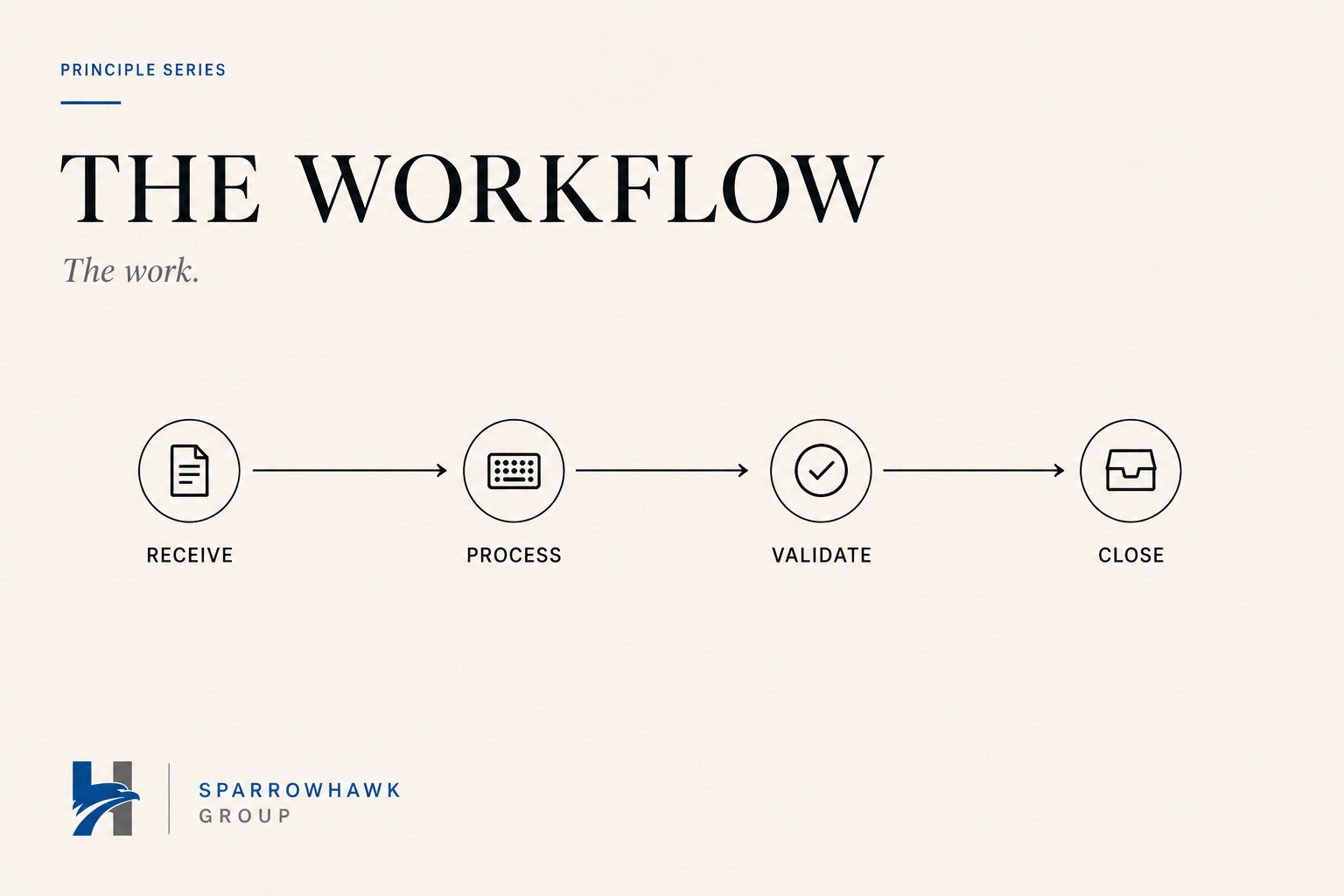
The container does not disappear. It multiplies.
The promise of operational improvement has remained remarkably consistent for two decades. Pick your intervention, whether AI, robotic process automation, outsourcing, restructuring, or a new platform, and the pitch barely changes. Shift the workload to the faster or cheaper system. Unit costs decline. Internal capacity gets freed. The retained organization redeploys itself toward higher-value work.
The unit economics are often correct.
The organizational assumptions are not.
The freed capacity rarely disappears onto the P&L. It gets reabsorbed. Into governance. Into exception handling. Into meetings about the thing that was supposed to eliminate meetings. Into the slower operational pace organizations gradually permit themselves once the original pressure on the workflow is gone.
The retained team refills the freed capacity rather than subtracting work.
The container just changes shape.
You haven’t eliminated the operation. You’ve created a second one. The workflow originally targeted by the intervention now lives in parallel systems: one absorbs the original workflow, the other absorbs the management overhead generated by the intervention itself. Whether the second operation is a BPO partner, an RPA deployment, an AI platform, or an internal reorganization, the container changes shape rather than disappears.
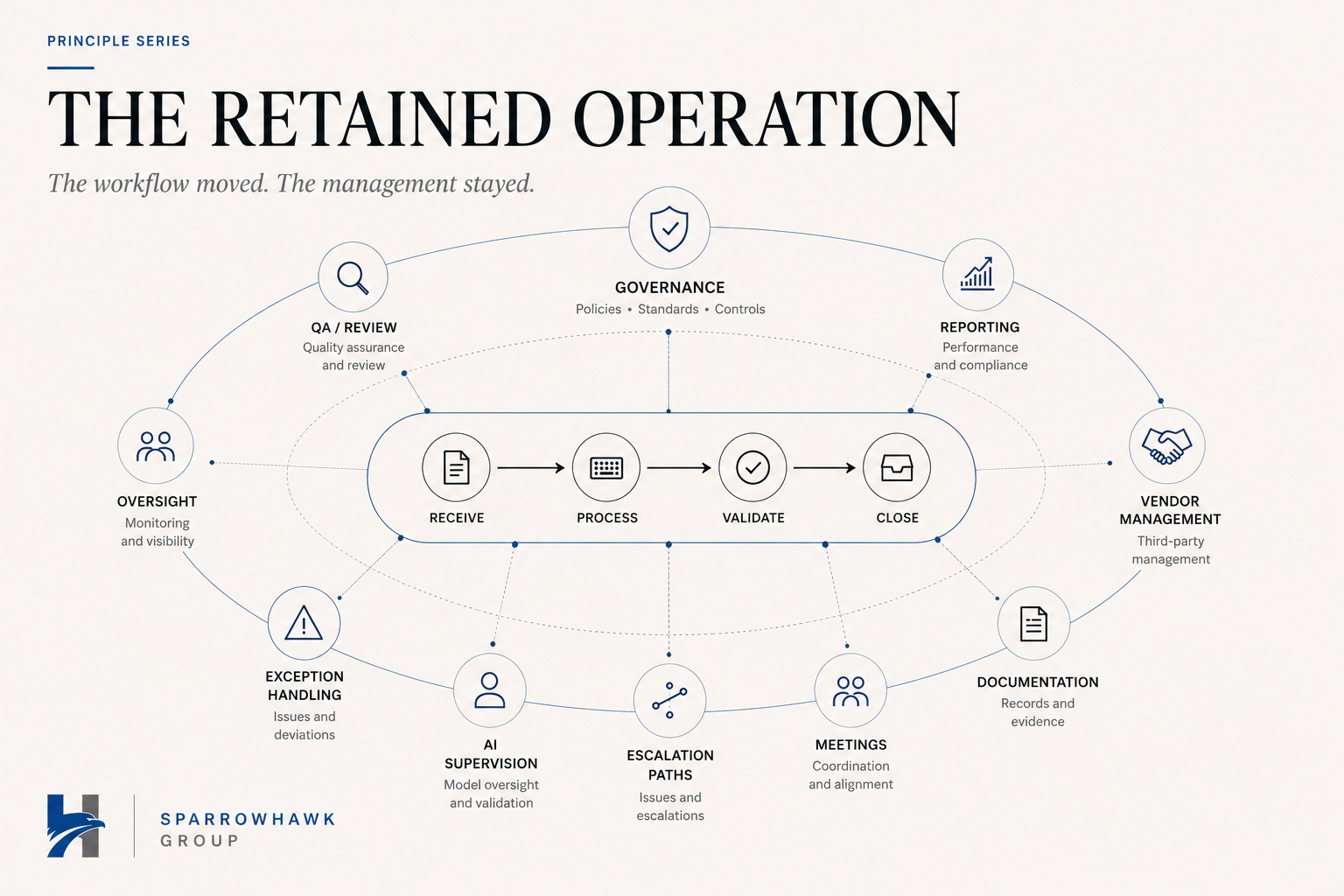
A note on the source of this argument. SparrowHawk operates as an outsourcing provider, one of the interventions under critique here. The carriers who get real value from outsourcing are the ones whose internal teams reorganize around what we take off their plate. The ones who don’t usually end up with a more complicated version of the same operation they started with.
The lever doesn’t matter. The discipline does.
The evidence has been pointing in the same direction for years.
This isn’t a novel observation.
The literature is deepest in outsourcing, partly because outsourcing produces contracts and post-engagement audits in ways internal restructures and automation rollouts often do not. The dynamic itself is not outsourcing-specific.
The measurement is.
That distinction matters.
In 2013, KPMG and HFS Research surveyed 1,355 senior leaders at enterprises and the providers and advisors who serve them. Eighty-eight percent reported satisfaction with the cost reductions their outsourcing engagements delivered. The same buyers reported that providers were falling short in the strategic areas, such as analytics and innovation, that would have translated freed capacity into higher-value work.
The cost ledger was satisfied. The strategic ledger was not.
Six years later, Deloitte’s Global Shared Services Survey produced one of the sharpest data points in the literature. Across 379 respondents managing more than 700 shared services centers, the survey asked what level of savings their robotic process automation programs had actually achieved.
Fifty-three percent reported less than 10 percent. Eighty percent reported 20 percent or less. The business cases had typically projected 30 to 50 percent.
When automation unambiguously removes labor and the savings still fail to materialize financially, the freed capacity has gone somewhere.
It just didn’t land on the P&L.
+24%
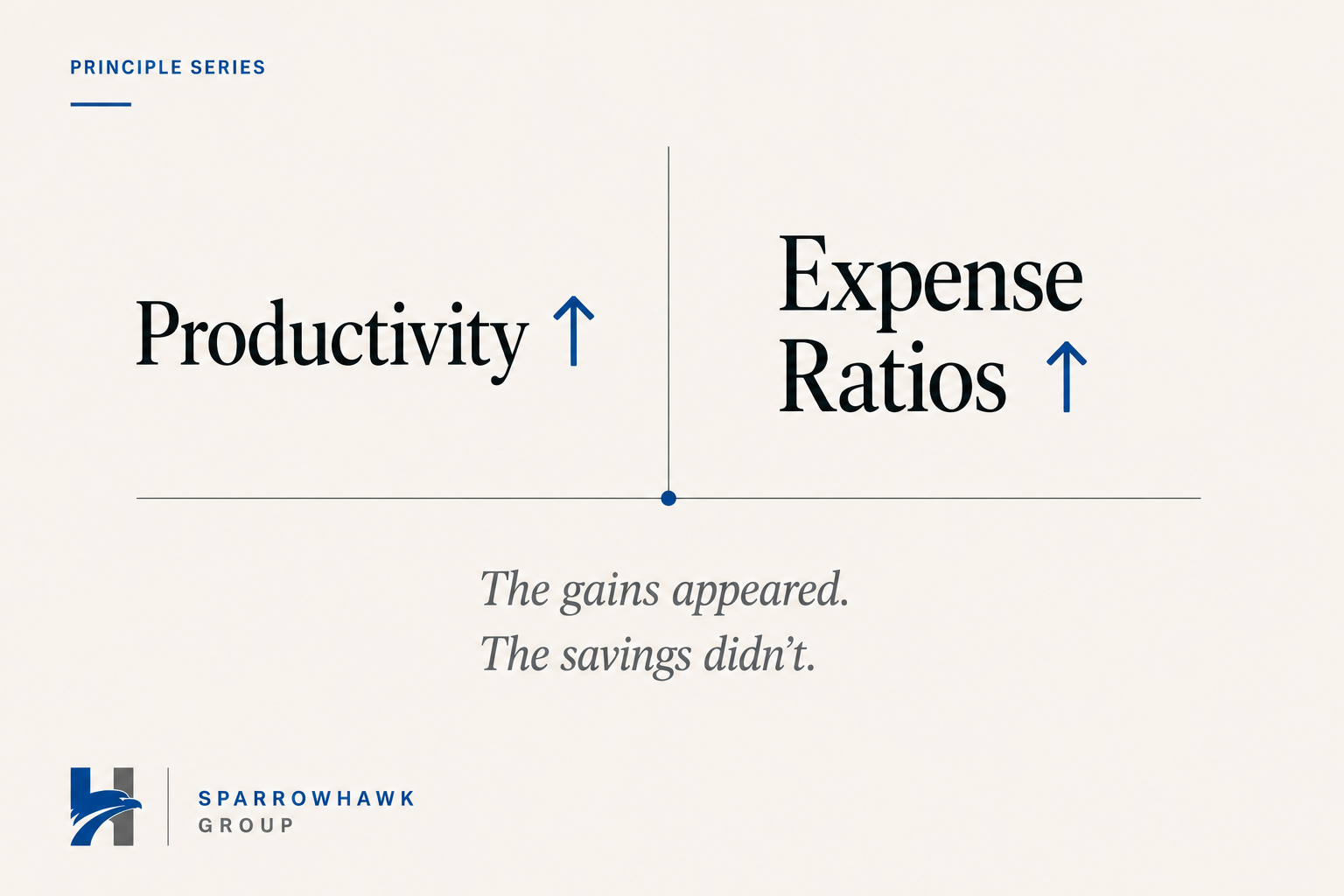
Life carriers raised labor productivity 24 percent between 2012 and 2017, and P&C carriers 14 percent — even as industry cost ratios kept rising.
Source: McKinsey & Company, “The productivity imperative in insurance,” August 14, 2019.
McKinsey’s 2019 insurance analysis is the most damaging finding of all because it was not tied to any single intervention category. Between 2012 and 2017, life carriers increased labor productivity by 24 percent and P&C carriers by 14 percent. At the same time, industry cost ratios continued rising despite an era defined by automation, outsourcing, restructuring, and platform modernization.
The productivity gains were real.
They simply did not consistently land on the cost base.
The capacity claim at the center of every category is rarely audited.
This is the uncomfortable part.
The capacity-gain claim sits at the center of nearly every productivity category. It appears in outsourcing proposals, AI sales decks, automation business cases, operating-model redesigns, and transformation initiatives of every variety.
The intervention changes. The promise rarely does.
And the productivity of retained teams after these interventions is almost never measured.
In insurance specifically, the vendor literature is overwhelmingly promotional. The carrier-side measurement literature is remarkably thin. No published study meaningfully tracks the productivity of retained underwriting, claims, or servicing teams after major operational interventions. The figures repeated across categories, such as cost reductions and throughput gains, are usually projections, with the retained organization assumed.
The capacity claims across the category are heavily projected.
They are less heavily measured.
This includes ours.
Why this happens, and why it isn’t a failure of effort.
It would be tempting to interpret all of this as evidence that internal teams simply are not working hard enough.
That reading is wrong. It’s also lazy.
Parkinson’s Law operates through structural mechanisms, not moral ones.
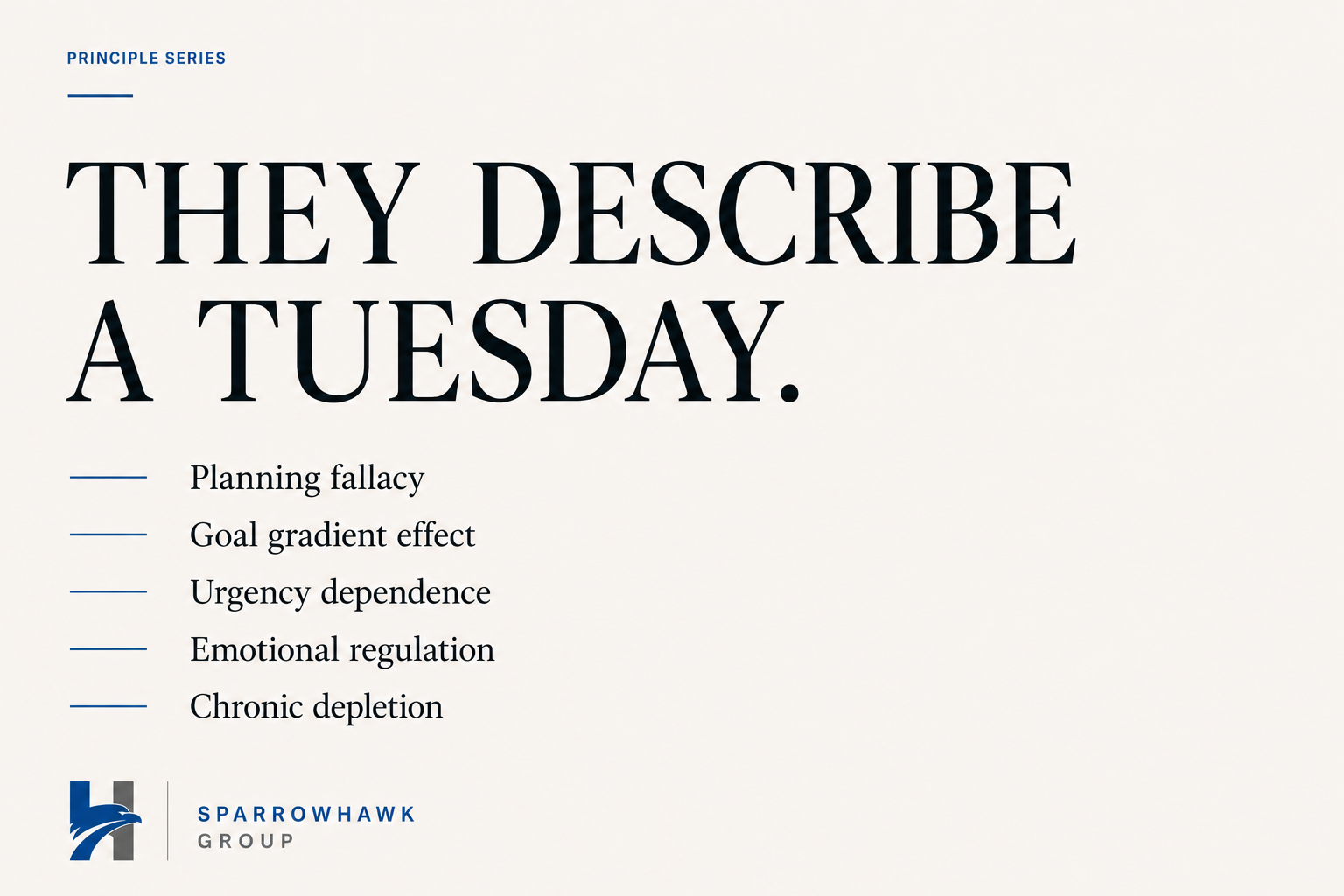
Start with the planning fallacy: effort is systematically underestimated, and without counterpressure, optimistic timelines become operational reality.
The goal gradient effect. Motivation rises as deadlines approach. Remove the deadline and the same team often behaves differently on the same work.
Urgency dependence. Some cognitive styles require external scaffolding to activate executive function. Work gets stretched rather than avoided.
Procrastination as emotion regulation. Ambiguous or emotionally costly work expands because stretching it creates short-term psychological relief.
Chronic depletion. Burnt-out organizations diffuse work to protect remaining capacity.
None of these describe moral failure.
They describe a Tuesday.
The macroeconomic version of the same observation, Erik Brynjolfsson’s productivity paradox, has been documented across IT and automation for decades, and now AI. Expected productivity gains routinely fail to appear in aggregate statistics. The clash between projection and measurement is not a side effect.
It is the operating environment.
What the second container looks like inside insurance operations.
In carrier operations, the pattern shows up most clearly in renewal timing, submission triage, and audit closure:
The 90-day cycle that takes 90 days because the organization has 90 days.
The submission backlog calibrated to tolerance rather than volume.
The audit file that closes at the limit of administrative patience rather than technical complexity.
A representative scenario.
A carrier outsources 40 percent of policy issuance to a BPO partner. Unit costs decline, as projected. Six months later, the underwriters who were supposed to spend the freed capacity on broker relationships are managing the outsourcing relationship instead. The expense ratio holds steady. The capacity gain is real on paper and invisible on the P&L. Leadership concludes the engagement is “woring” because the contractual savings are real, but nobody measured what happened to the retained organization after the intervention.
Eighteen months later, the same carrier evaluates an AI intake platform using the same business-case structure and the same unmeasured assumptions. Different intervention. Same pattern.
The organizations that hold the gain behave differently.
The conclusion isn’t that operational interventions fail. AI, outsourcing, automation, restructuring: all of them can produce legitimate gains. The problem is that organizations routinely fail to defend those gains after they appear.
The firms that actually hold the gain tend to share the same characteristics: outcome-based measurement, explicit redeployment plans, mature governance structures, and clear accountability around what the retained organization is expected to become after the intervention succeeds.
The capacity gain is the point.
If it never reaches the carrier’s P&L, the intervention succeeded operationally and failed economically.
Close.
Parkinson’s Law follows organizations across interventions, technologies, and operating models. Move the workflow and it expands again in its new container. Automate it and the savings dilute. Deploy an AI agent and the freed time gets absorbed into the governance work the agent created. The intervention changes, but the pattern doesn’t.
Every productivity gain decays unless someone explicitly protects it.
The work follows you. What matters is whether you reprioritize what’s left.