

Cargo Cult Thinking: copying the runway, missing the supply chain.

Procuring the artifact does not procure the capability that made the artifact useful. The runway is not what landed the planes
On the island of Tanna in the South Pacific, in the years following the Second World War, villagers built bamboo control towers, carved wooden headsets, and lit grass airstrips at night to wait for the planes to return. During the war, Allied operations across Melanesia had brought cargo on a scale the islanders had not previously encountered. When the bases were dismantled, the cargo stopped. Some communities, working from the best available model of what had produced the cargo, reproduced what they had observed: the runways, the towers, the ceremonies. The form was reproduced. The cargo did not return.
Richard Feynman brought the metaphor into the business vocabulary in his 1974 Caltech commencement address. His point was that the rituals, the controls, the citations, the methodology, were necessary but not sufficient. The form was reproducible; the function was not. The Melanesian movements were rational responses to an extraordinary intrusion; the islanders are not the comic referent of this principle. The modern enterprise is.
The runway doesn’t land the planes. The supply chain does.
The corporate version is the most common procurement mistake in insurance. An organization observes a high-performing peer, identifies the visible artifacts- the platform, the framework, the ritual- and procures them in the expectation that the result will follow. The peer's result was generated by capabilities that are not visible from the outside: data hygiene, decision rights, talent density, operating discipline. The artifact is downstream of the capability. Procuring the artifact without the capability produces the appearance of the operation, not the operation itself.
The same mistake repeats at every link in the insurance chain, with different artifacts.
A retail agency buys the management system the largest shop in town runs on, expecting that shop's growth to follow. The growth came from disciplined data entry, producer accountability, and a service workflow the system only enabled. Installed over inconsistent data, the same system becomes a more expensive version of what the agency already had.
An MGA replatforms onto the policy administration system, a faster-growing program, crediting its speed-to-market. The speed came from tight product definitions and clean data standards the system only executed.
A wholesaler launches the instant-quote portal that a competitor just advertised, while its appetite remains ambiguous and submissions are still triaged by hand. The portal becomes a faster front door to the same bottleneck.
A carrier licenses the AI triage platform from a peer's case study that cites a 40 percent reduction in submission-to-quote cycle time. The case study does not foreground the eighteen months the peer spent cleaning appetite documentation, training brokers against revised templates, and tightening data hygiene at intake before the platform arrived.
In each case, the platform did what it was sold to do. The capability that made it work for the peer was never part of the purchase. (All examples illustrative.)
The platform is the runway. Buy the supply chain.
~70% of large-scale digital transformation initiatives fail to achieve their stated business objectives. The most-cited drivers are not the technology itself but the absence of operating-model change, data readiness, and behavioral adoption around the technology.
Source: McKinsey & Company, with consistent findings reported by BCG, Gartner, and Bain.
This is the uncomfortable part. The capability-gain claim, that the platform will produce the peer's result, sits at the center of nearly every enterprise technology purchase. SparrowHawk is on the provider side of the same dynamic; the principle series is the firm's attempt to name it openly. The discipline the piece is arguing for is the buyer's, not the provider's. A sound evaluation runs a parallel inventory of the capabilities the peer had before the platform arrived, set against the capabilities the buyer does not yet have.
The organizations that reproduce a peer's result are, almost without exception, the ones that did the operating-model work alongside the procurement. The platform was the visible part. The discipline was the part that mattered.
DIAGNOSTIC QUESTIONS
When you last procured a platform on the basis of a peer's result, did you audit which of the peer's pre-existing capabilities the platform depended on?
Which of your current "best practices" can you trace to a documented mechanism, and which are inherited from companies that simply happened to succeed?
When a technology investment underperforms, do you re-examine the operating model around it, or buy the next platform?
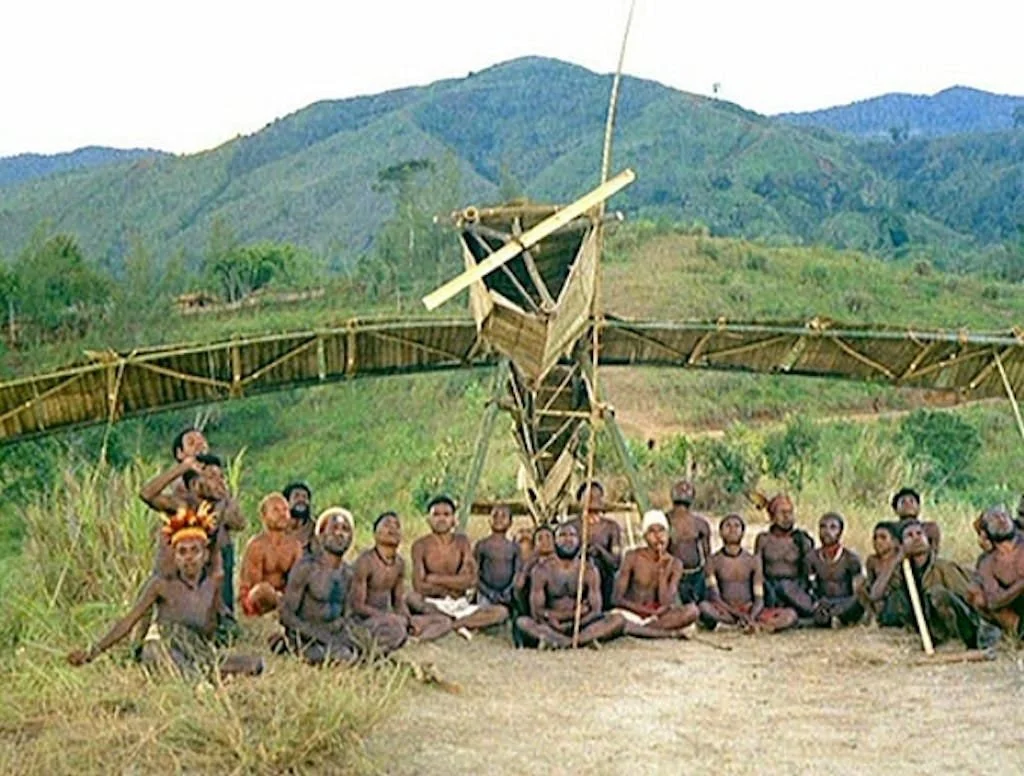
The Melanesian villagers were working from the best available model of cause and effect, in a context in which the actual cause and effect was outside their information set. The modern operator procuring a platform on the basis of a peer's public case study is doing the same thing, with more information and less excuse. The remedy is not skepticism about platforms. The remedy is a parallel inventory of the capabilities the platform was downstream of. The platform is the runway. Buy the supply chain.
An interactive self-assessment: check which of seven cargo-cult patterns describe your operation to get a score and reading.
Borrowed Ideas · Principle Series
The Cargo Cult Audit
Seven patterns that signal an organization is reproducing the form of success without the function underneath it — buying the runway, not the supply chain.
Check the ones that sound like your operation.
- 01You adopted a tool, system, or framework because a respected competitor used it, without auditing what they had in place before it worked for them.
- 02You can describe what a high-performing peer does, but not the conditions that make it work.
- 03Your “best practices” are inherited from companies that succeeded, and you cannot trace the practice to the mechanism that produced the result.
- 04The rituals are running — the dashboards, the portal, the scorecards — but the behavior they were meant to create has not changed.
- 05You judged a project a success because it went live on time and on budget, not because the capability improved.
- 06When something underperforms, the reflex is to buy the next tool rather than examine the operating model around it.
- 07The people expected to use the new system were the ones whose underlying process was weakest, and that was not fixed first.
Start checking the boxes
Each box you check is a place where the visible artifact may be standing in for a capability you have not actually built.
If this audit hits a nerve, you might be our kind of operating partner. The remedy is a capability inventory — a parallel accounting of what the result you admire was actually built on, and what you do not yet have.
Request an Ops Audit or call 888-467-7495